


Europe’s ICT Workforce Under the Microscope: Tracking Europe’s Digital Skills Reality
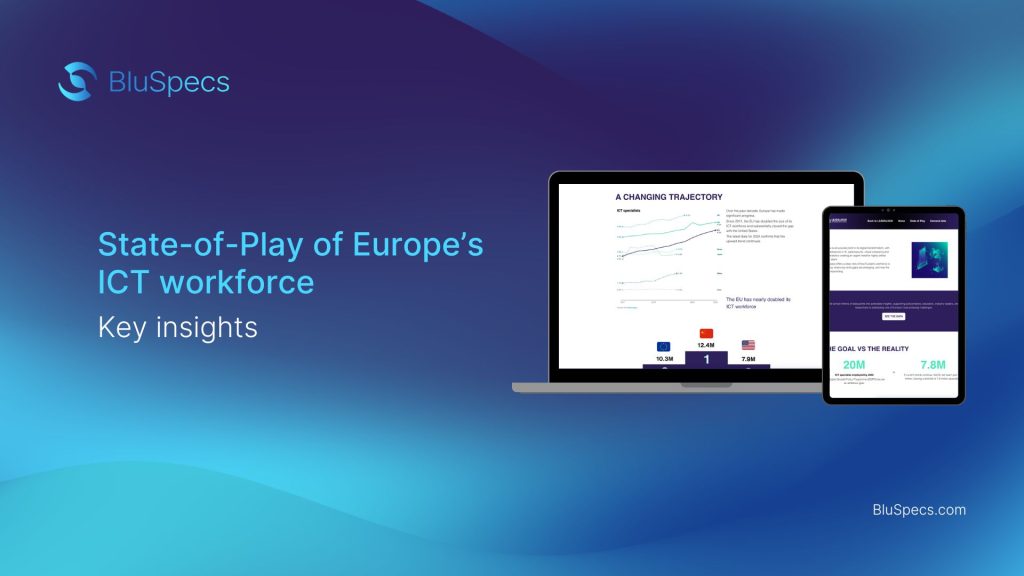
Europe is racing through a digital transformation driven by AI, cybersecurity, cloud and data technologies. But are we building the digital workforce fast enough to keep up?
The LEADSx2030 State-of-Play interactive page offers a clear, data-driven snapshot of where Europe stands today, where the gaps are emerging, and how far we still need to go to meet the EU’s Digital Decade ambitions.
Ambition vs reality
The EU has set a bold target: 20 million ICT specialists by 2030.
Based on current trends, Europe is on track to reach only 12.2 million, leaving a shortfall of 7.8 million professionals. At this pace, the target would not be met until 2051.
This gap puts pressure on Europe’s competitiveness, its ability to deploy emerging technologies, and progress towards both the green and digital transitions.
Where Europe stands today
The dashboard reveals a mixed picture. Europe now has the second-largest ICT workforce globally, surpassed only by China. Since 2011, the EU has doubled its ICT workforce and significantly narrowed the gap with the United States. Scale is a real strength.
Yet challenges remain:
- ICT specialists account for just 5% of the total workforce
- Only 56% of ICT professionals work within the ICT sector, with the rest spread across manufacturing, finance, professional services and retail
- Women represent just 19.5% of ICT specialists, a figure that has barely shifted in a decade
Investment is happening, but speed matters
Through the Digital Europe Programme, the EU has invested €407 million in advanced digital skills via Strategic Objective 4, supporting master’s programmes, short courses and initiatives like the Cybersecurity Skills Academy. These efforts are strengthening the talent pipeline, but the dashboard shows that progress is still too slow to meet demand.
What the data tells us about demand
Using an AI-powered data model, LEADSx2030 analysed millions of online job advertisements. For 2025, AI, data science and cybersecurity dominate demand, while skills related to governance, security and data management are growing rapidly. Shifts away from areas like IoT or cloud do not signal decline, but rather changing hiring cycles and market maturity.
Why the State-of-Play matters
The State-of-Play dashboard turns complex data into actionable insight. It supports policymakers, educators, industry leaders and researchers in making informed decisions about training, investment and workforce planning.
Europe has momentum, ambition and scale. What it needs now is accelerated action, stronger coordination and a deeper commitment to inclusion. The State-of-Play exists to help Europe navigate that journey with clarity, evidence and foresight.